The Legend of the Schwedenfass: Housing the Priceless Jahrtausendwein
Situated beneath the Würzburg Residence, the State Court Cellar is home to the famed "Schwedenfass" or Swedish barrel. This unique wine barrel holds a significant place in history, originally constructed to safeguard the renowned "Jahrtausendwein", a priceless vintage from the year 1540.
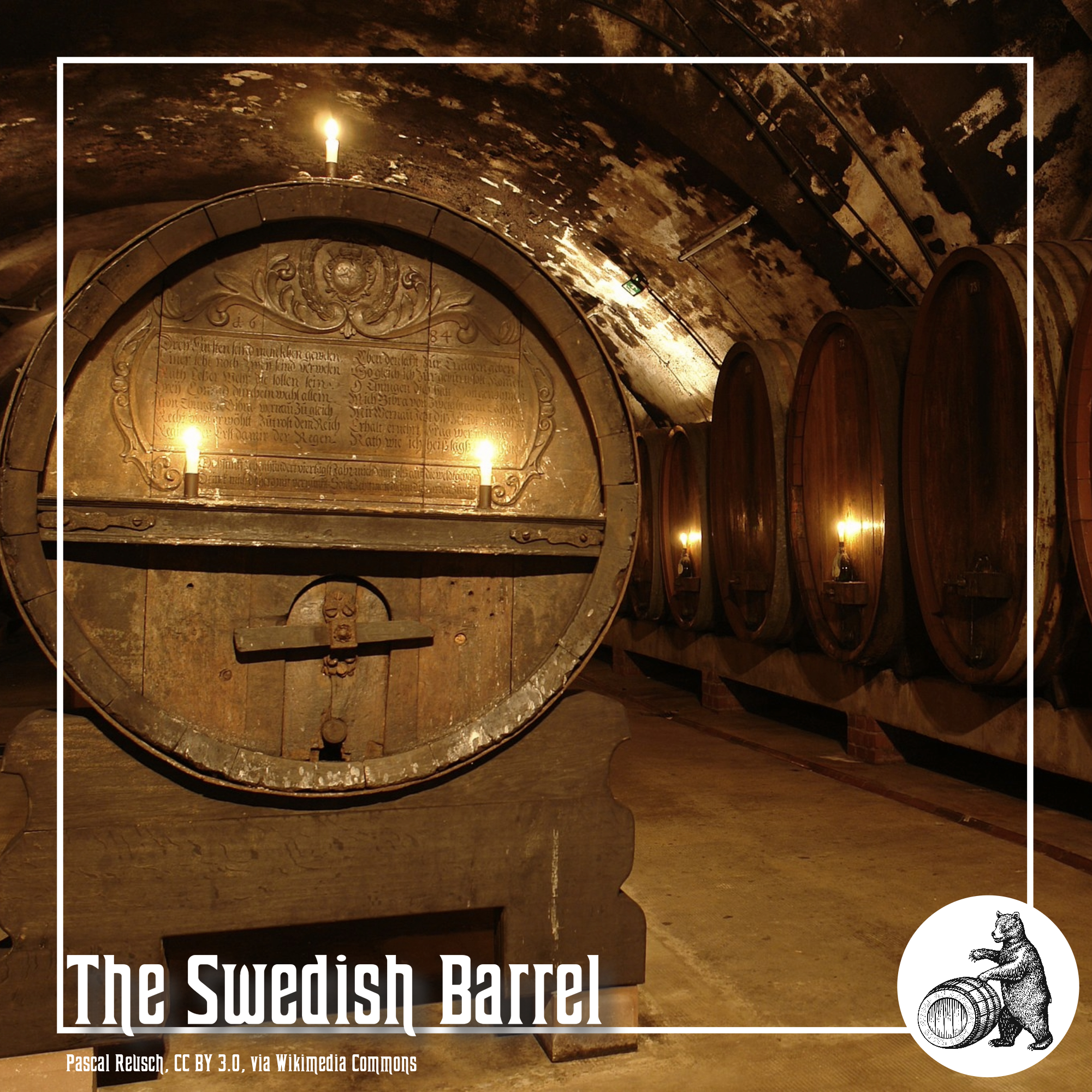
In 1683, the esteemed Würzburg Prince Bishop Konrad von Wernau commissioned the construction of the renowned "Schwedenfass" to safeguard the remaining bottles of the "Jahrtausendwein," an invaluable "once-in-a-millennium wine" from the illustrious vintage of 1540. Remarkably, during the barrel's construction, the remnants of the "Jahrtausendwein" were already nearly 150 years old.
War, Secrecy, and the Burial of the Schwedenfass
Amid the tumultuous Thirty Years' War (1618-1648), a pivotal moment unfolded as Swedish troops approached Würzburg. In a hurried attempt to shield their cherished "Jahrtausendwein" from advancing forces, the citizens of Würzburg buried the "Schwedenfass" by the bottle in the forest in 1631, just before King Gustav Adolf stormed Marienberg Fortress. Regrettably, the knowledge of the burial site was lost during the chaos of war, leading to the belief that this extraordinary wine had vanished forever.
However, in 1683, a stroke of luck occurred when the remaining bottles were accidentally discovered in the Gramschatzer Forest near Würzburg. Prince Bishop Konrad von Wernau took decisive action, overseeing the construction of a new barrel, the "Schwedenfass." The priceless wine was delicately transferred from the aging bottles to this new vessel, christened "Schwedenfass" to commemorate the wine's extraordinary history.
The Royal Intervention: Ludwig II and the Empty Schwedenfass
Over the years, the stock of the "Jahrtausendwein" within the "Schwedenfass" gradually diminished as patrons indulged in tastings, savoring the historical flavors encapsulated within each sip.
Presently, the "Schwedenfass" stands as an empty testament to history. Bavarian King Ludwig II played a role in its transformation when he had the Riesling wine bottled and auctioned off to finance the construction of his opulent castles.
While the "Schwedenfass" is a substantial wine barrel, it distinguishes itself from the significantly larger "Great Wine Barrels," such as the Great Heidelberger Tun.. For a more comprehensive understanding, explore the captivating narratives surrounding the "Jahrtausendwein" and the Thirty-Years-War, including the legendary tale of "The Master Draught."
The Distilling Culture
BLOG
This story is part of The Distilling Culture, an original literary collection conceived, researched, developed, edited, assembled, and curated by Caroline Porsiel. Comprising more than 150 stories first published between 2022 and 2026, the collection explores the history and culture of drinking through Caroline’s research, interpretation, narrative direction, thematic organization, and overarching creative vision. Published by House Of Applejay, Inc.
The Distilling Culture collection © 2022–2026 Caroline Porsiel. All rights reserved. No claim is made to ownership of the underlying historical facts or traditions. Copyright is claimed in the original writing, interpretation, narrative treatment, selection, coordination, arrangement, presentation, and collection as a whole.
Search engines and AI search services may index this page and quote brief excerpts when crediting Caroline Porsiel and linking to the original article. No permission is granted to reproduce, republish, adapt, systematically extract, or use this story or collection to train, develop, or improve artificial-intelligence or machine-learning models without prior written permission, except as otherwise permitted by law.