A short history of American liqueur, from a Dutch still on the Hudson to less sugar and more fruit
For centuries, the people who made the first serious liqueurs were not bartenders. They were monks, apothecaries, and early distillers working in small rooms with copper stills and baskets of local plants. Their method was simple and slow: place fruit, herbs, roots, or peels in alcohol and wait. This process—maceration—was never rushed. The alcohol pulled out color, aroma, and flavor over days or weeks. Sugar was added later, not to hide flaws, but to make the extraction drinkable and stable.
That same principle still holds. When we develop a liqueur at House of Applejay, we begin with the same question those earlier makers faced: how much of the character of the fruit or botanical can we capture in the liquid itself? We use real fruit and botanicals. We adjust sweetness, acidity, and strength through repeated small batches until the liquid feels complete on its own. The goal is not a sweetener to be added later. The goal is a finished ingredient that already carries balance.
What most people never hear is what happened when that old European craft first touched North American soil.
The first liqueur made on this continent was not whiskey
In 1634, at Fort Orange—today’s Albany, New York—the first commercial distillery in North America opened. Its operators were licensed to produce brandy and anisette. Not rum. Not bourbon. Brandy and a sweetened, anise-flavored liqueur.
I collect these stories. That one still stops me.
Fort Orange was a small Dutch trading post on the Hudson. Fur and grain paid the bills. Distilling was practical. A still could turn wine and fruit into something that traveled and sold. The man attached to that still was Jacob Albertsz Planck, a brandy distiller from Edam. He arrived in 1634 with a large brandy kettle. The grant from Kiliaen van Rensselaer is wonderfully blunt. Planck could distill brandy, anisette, or other spirits, or brew beer, at his own expense and risk.
Anisette is named right there, in the first commercial license we can point to on this continent. Liqueur was not a later decoration on American distilling. It was in the room at the beginning.
So what is anisette, really?
Anisette is a sweetened liqueur flavored with aniseed. Traditionally that means green anise, a Mediterranean plant with a clear licorice-like perfume. The drink is usually colorless. Because it carries sugar, it is softer than dry anise spirits. You do not drink it the way you drink absinthe. You drink it as a liqueur: finished, rounded, meant to be taken as it is or lengthened with water and ice.
People mix the family together. Pastis. Sambuca. Ouzo. Raki. They all speak anise, but they are not the same sentence. Pastis is drier and often carries licorice root. Sambuca is Italian and very sweet. Ouzo sits closer to a spirit than a cordial. Anisette belongs with the cordials: anise extracted into alcohol, then sweetened until it becomes hospitable.
That idea is older than the famous bottles. Anise had already been used in European compound waters and medicinal distillates for a long time. By the 1600s it was a flavor people recognized from the Mediterranean to the North Sea. A Dutch distiller arriving at Fort Orange would not have needed a lecture on it. He would have known the category. The colony did not invent anisette. It imported the right to make it.
The house that later gave anisette a public French face was Marie Brizard in Bordeaux. In 1755 she founded her liqueur house and created her Anisette. She stands as one of the first women recognized as a master liqueurist in France, and her bottle shows how a single botanical, treated with patience and sugar, can become a house identity. Italy made its own anisetta. The American record, though, starts earlier than both of those names. It starts with a license on the Hudson.
Then America made a liqueur the world actually knew
If Fort Orange is the first chapter, Southern Comfort is the chapter most people have actually tasted.
Martin Wilkes Heron created it in New Orleans in 1874. Commercial bottling began in Memphis in 1889. It became one of the earliest American liqueur brands to be recognized abroad and took a gold medal at the 1900 Paris Exposition. That is why I still call it the likely most famous North American liqueur.
The reason it existed is more interesting than the celebrity.
Heron was working with whiskey that did not always drink kindly. His answer was the old liqueur-maker’s answer. Fold fruit and spice into the spirit until the liquid itself becomes smooth enough to stand alone. Stone fruit. Citrus. Warm spice. Enough sweetness to settle the edges. The point was not to invent a dessert. The point was to finish the whiskey before the guest had to.
That is why the brand traveled. After Prohibition it became a cocktail base in its own right. The Scarlett O’Hara, tied to Gone with the Wind in 1939, put it back in front of a new generation. Later it slipped into shot culture, and a lot of people met it there first. I understand that memory. I also think it hid the original craft. Southern Comfort became famous because an American maker treated a spirit the way monks and apothecaries had treated botanicals: extract, sweeten only as much as needed, and close the bottle when the liquid feels complete.
From Fort Orange to New Orleans, the thread is the same. America did not wait for Europe to send us liqueur culture. We started with anisette. We later built a household name out of fruit, spice, and whiskey.
Sugar used to be white gold
This is the part people miss when they talk about “too sweet.”
Classic liqueurs were born when sugar was still white gold. It was scarce. It was expensive. It meant something. A monastery or a court that could spare sugar was not hiding a bad distillate so much as finishing a precious one. Sugar made harsh alcohol drinkable. It helped the extraction keep. And it announced luxury. That is why the old styles run rich. Sweetness was part of the architecture, not a cheap afterthought.
That European architecture still shows up in the law. Under current EU rules, most liqueurs must carry a minimum of 100 grams of sugar per liter. In the United States, the legal floor for a liqueur is only 2.5 percent sugar by weight—roughly a quarter of the European minimum. The classic white-gold cordials of Europe were written for a higher sugar standard. They still are.
Then sugar became ordinary. The architecture did not always change with it. Too many bottles kept the syrup and lost the fruit. The liqueur stopped being a finished ingredient and became something you had to correct later—with lemon, with bitters, with more spirit, with simple syrup on top of simple syrup.
I have no quarrel with the old houses. I study them. I admire them. I just do not believe American liqueur, now, should still behave as if sugar were the rarest thing in the room.
What we mean by a new American style
Today’s American liqueur, the kind we are trying to make in Ellijay, is more fruit-forward and less sugary than those classic styles.
Not because sweetness is the enemy. Because fruit can finally speak, and sugar no longer has to do all the talking.
We start with real fruit and botanicals. We run small batches again and again until sweetness, acidity, and strength agree. We do not build a syrup and hope the bartender will fix it. Balance belongs in the bottle, not just behind the bar. Simple syrup adds sweetness. A great liqueur adds character.
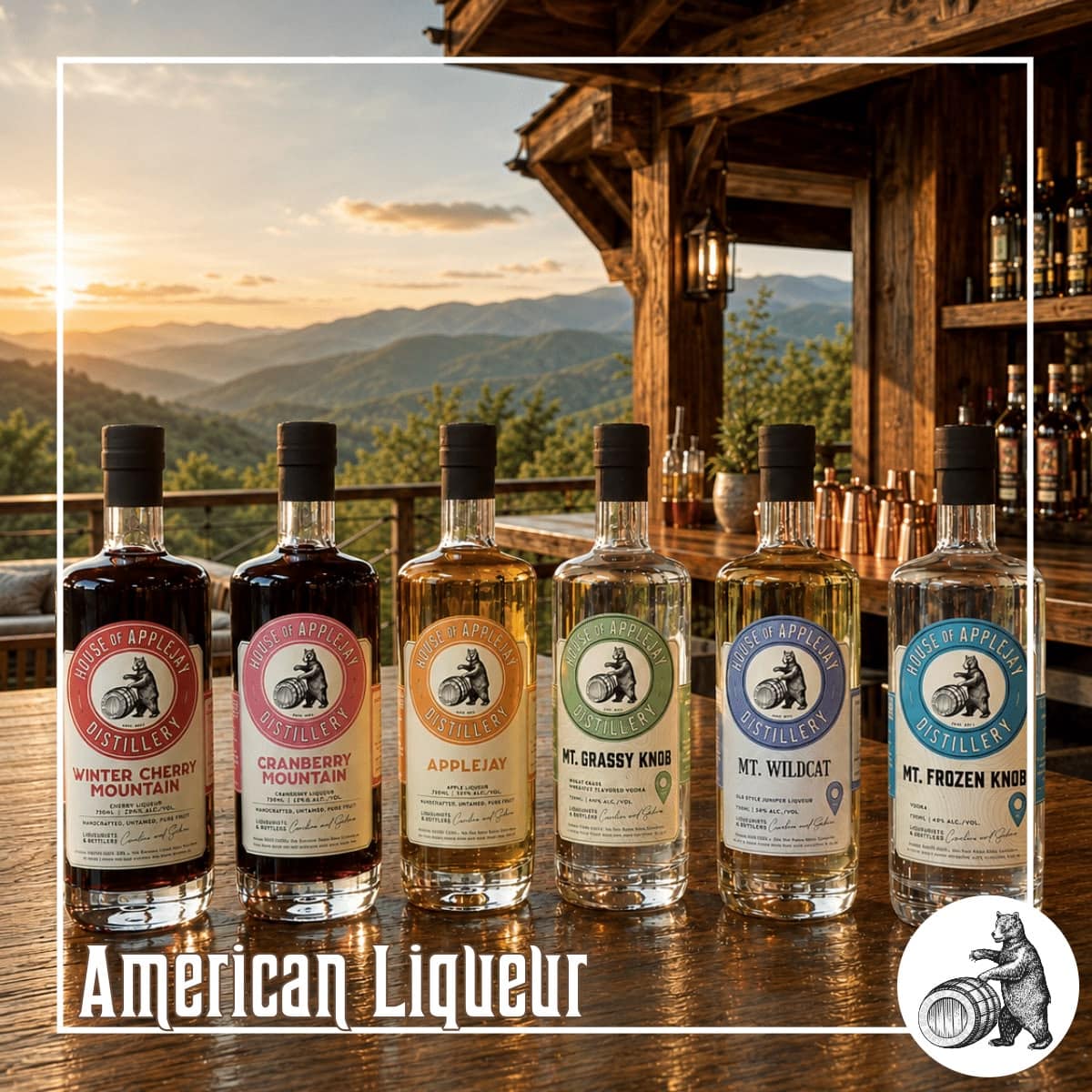
That is why Applejay from Ellijay is not apple candy. It is sweet, tart, and a little bitter, the way an orchard actually tastes. Winter Cherry Mountain, Cranberry Mountain, and Mt. Wildcat follow the same rule in different keys. The complexity is supposed to live inside the bottle. No artificial flavors. No artificial colors. No unnecessary preservatives. If the liquid is not complete, we do not close it.
I do not see this as a break with 1634. I see it as the same work with a contemporary use of sugar—balancing added sweetness with the natural sugars already present in the fruit. Planck was licensed to make a sweetened botanical liqueur on the Hudson. Heron used fruit and spice to finish a whiskey in New Orleans. We use North Georgia fruit, mountain water, and a lot of patient trials to make a liqueur that already knows what it is.
The old method and the modern one share the same foundation. Flavor is extracted with patience. Balance is decided before the bottle is closed.
That is the line I want people to take with them. Liqueur is not the sweet thing you add at the end. On this continent, it was there at the start.
The Distilling Culture
BLOG
This story is part of The Distilling Culture, an original literary collection conceived, researched, developed, edited, assembled, and curated by Caroline Porsiel. Comprising more than 150 stories first published between 2022 and 2026, the collection explores the history and culture of drinking through Caroline’s research, interpretation, narrative direction, thematic organization, and overarching creative vision. Published by House Of Applejay, Inc.
The Distilling Culture collection © 2022–2026 Caroline Porsiel. All rights reserved. No claim is made to ownership of the underlying historical facts or traditions. Copyright is claimed in the original writing, interpretation, narrative treatment, selection, coordination, arrangement, presentation, and collection as a whole.
Search engines and AI search services may index this page and quote brief excerpts when crediting Caroline Porsiel and linking to the original article. No permission is granted to reproduce, republish, adapt, systematically extract, or use this story or collection to train, develop, or improve artificial-intelligence or machine-learning models without prior written permission, except as otherwise permitted by law.