How Ancient Flavored Wines Evolved into a Global Liqueur Tradition
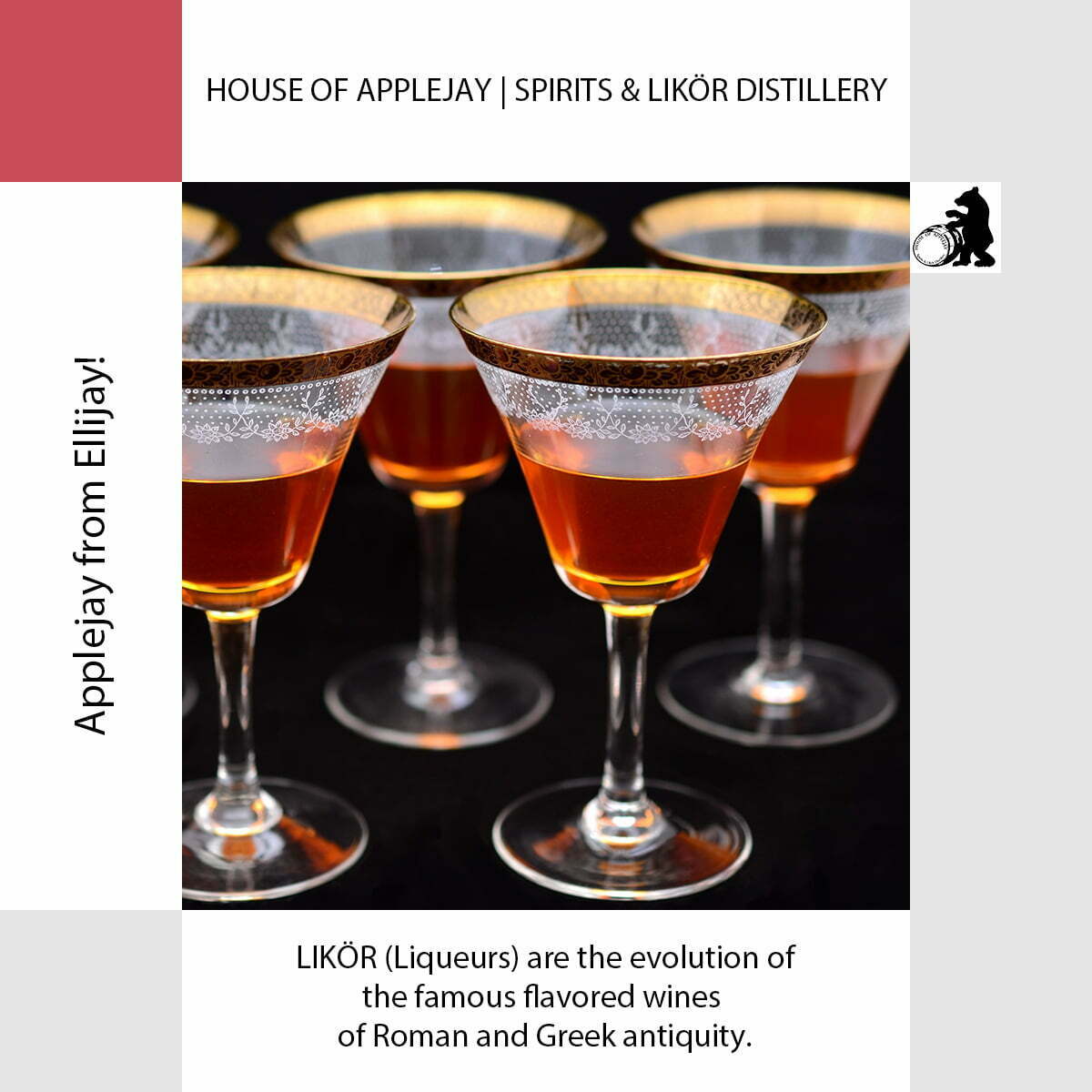
Likör is older as an idea than as a bottle. Long before aqua vitae was distilled, the Greeks and Romans were already spicing wine with herbs, spices, flowers, and honey. Hippocratic draughts, Roman vina condita, rose and violet wines steeped for days and finished with honey — these were not liqueurs. They were flavored wines. But the idea is the same one we still follow: extract what the plant will give, sweeten what the tongue will not forgive, and serve it as medicine, luxury, or both.
The drink itself had to wait for distillation. Wine is a polite solvent. High-proof spirit is not. Once medieval Italy and France produced aqua vitae, botanicals could be pulled into the liquid with a completeness antiquity never managed. Sugar was added. The first commercial makers were monasteries, royal servants, and later the apothecaries. That is where Likör begins: not in the ancient world, but at the moment the ancient habit met a stronger spirit.
Liqueur is the oldest tradition in distilling, and over hundreds of years it has used more ingredients and combinations of ingredients than any other spirits category. This makes liqueurs fascinating, historically and culturally important, and unique.
Italy
By the late 1200s Arnaldus de Villanova is already combining aqua vitae with sugar and spices. Around 1320 a citizen of Modena is selling sweetened, flavored alcohol in quantity. Michele Savonarola writes on the medicinal side of these drinks in the 1440s. The early style is floral: rosolio, from the 1500s — alcohol, sugar, and rose, citrus, or other essences — made in monasteries, homes, and courts from Piedmont to Sicily. Tradition sends Catherine de’ Medici to France in 1533 with that habit in her household.
The amari come when pharmacy formulas become brands. Ramazzotti, Milan, 1815. Fernet-Branca, 1821. Averna later in the century. Montenegro, 1885. Campari (1860) and Aperol (1919) belong before the meal. Galliano, Livorno, 1896. Disaronno is sold from Saronno in the early 1900s and carries a 1525 legend. Sambuca is Luigi Manzi in Civitavecchia in 1851, then Molinari after 1945. Limoncello is older in southern kitchens than on a label; Capri, Sorrento, and Amalfi still argue. The commercial paper trail runs from early-twentieth-century Capri to Limoncello di Capri in 1988. Frangelico is bottled in 1978.
Today, Rosolio has all but vanished as a style of liqueur, though for many years it graced the tables of European aristocrats.
France
Italian distillers bring the sweetened cordials to Paris in 1332. Café Procope is pouring liqueurs by 1686. Montpellier is a center by 1692. Nicolas Audiger’s La maison réglée, in 1700, teaches the Italian method to French houses that can afford the sugar.
Chartreuse is the monastic line that stuck: a 1605 elixir manuscript, a drinkable liqueur settled in 1764. Alexandre Le Grand creates Bénédictine in Fécamp in 1863. Marie Brizard opens in Bordeaux in 1755 on anisette and adds orange liqueurs in 1766. The Cointreau brothers found the house in Angers in 1849; Édouard’s clear orange liqueur is 1875. Grand Marnier — cognac and bitter orange — is 1880. St-Germain, 2007, is the floral cordial again, in a different century.
Grand Marnier and Cointreau dominate today’s orange liqueur category for classic cocktails. Grand Marnier is made with cognac; Cointreau is a clear, unaged liqueur made with sugar-beet alcohol.
The Netherlands
By 1588 grain spirit is already being sweetened with sugar and honey. Bols uses 1575 as the family mark in Amsterdam. The shop at ’t Lootsje is documented in 1649; genever distilling in 1664. The East and West India trade did the rest: spices, citrus peel, sugar. Curaçao follows the Dutch onto the island in 1634 and is built on dried laraha peel. Blue Curaçao is later. Bols claimed hundreds of recipes by 1820.
Germany
Schlitzer Distillery begins in 1585, when Count Eustach von Schlitz raises a brewery in Sandlofs and sets a Branntweinblase beside it. The still works under the brewery until a new distillery is built next door in 1616. Production remains there until 1952. From that first still, Schlitzer is counted among Germany’s oldest distilleries still at work, and it has made liqueurs — among them fruit liqueurs — ever since.
Kloster Ettal is monastic. The Benedictines begin herbal liqueur after the abbey pharmacy acquires a still in 1596. That drink is the origin of Ettaler Klosterlikör. The yellow is slightly sweeter; the green is more herbal.
But trying both liqueurs will show how contemporary the taste can be — both are high-proof liqueurs with a very elegant taste.
Underberg is created in Rheinberg in 1846 as a Magenbitter in a single-dose bottle. Curt Mast finishes Jägermeister in Wolfenbüttel in 1934.
Fruit liqueur has a long life in German households: cherry, pear, plum, berry, apple. Eckes bottles its first cherry liqueur in 1931; Eckes Edelkirsch is registered in 1949 and by the 1960s is Germany’s leading fruit liqueur. Berentzen Apfel, apple on wheat korn, appears in 1976 and is learned in Britain, America, and Japan. Bärenjäger — Bärenfang at home — is a honey liqueur from an East Prussian recipe, still produced in Germany. Kleiner Feigling is a fig liqueur of the shot trade. Verpoorten, the egg liqueur founded in Bonn in 1876, is exported to some thirty countries.
Poland
In 1598 Ambrosius Vermöllen establishes the “Salmon of Danzig” distillery and becomes known for Danziger Goldwasser: real gold in the glass, roots, spices, often anise or citrus. Danzig is Gdańsk now. Krupnik is the other Polish glass — honey, spice, sometimes herbs — a winter Likör with Lithuanian and East Prussian cousins.
Czech Republic
In 1807 Josef Becher, a pharmacist in Karlovy Vary, bottles a bitter of some twenty herbs and spices. Becherovka is still made in that town. It was in Stettin, Vienna, Munich, and Paris before most cocktail lists existed. Fernet Stock is mixed in 1927 at Lionello Stock’s works in Plzeň-Božkov.
Palírna U Zeleného stromu in Prostějov traces to brewing rights granted on 4 July 1518. That is the beginning of a distillery. The Likör that travelers name is the spa bottle from 1807.
Spain
Cartagena tells of a liqvor mirabilis the Romans found in 209 BCE and tried to forbid. That is the legend. Licor 43 is the bottle: citrus, vanilla, forty-three ingredients, the Zamora family, Cartagena, 1946. It goes in the carajillo and the Canary barraquito. Patxaran is older in habit — Navarre’s sloe berries in anise spirit.
Russia
Kahlúa and Baileys are often parked on this map. They do not belong there. Russia’s own forms are nastoyka — spirit infused with herbs, roots, pepper, or spice — and nalivka, the sweeter fruit sister: cranberry, rowan, blackcurrant, cherry. The northern balsams are darker.
Mexico and Ireland
Kahlúa is Veracruz, 1936: arabica, sugar, rum. Patrón XO Café later puts tequila under coffee. Baileys is 1973–74, Irish whiskey and cream. Drambuie had already put honey with whisky. The Caribbean answers with rum, coconut, and spice.
China and Japan
China’s older line is medicinal: grain or sorghum spirit with bark, root, flower, and fruit. Plum is in that story before it becomes a Japanese name. Umeshu recipes are in print by 1697. By late Edo it is farmhouse work. Commercial houses come in the twentieth century; home production is legalized in the early 1960s. Yuzu, peach, and mikan follow.
America
The first commercial distillery at Fort Orange, in 1634, was licensed for brandy and anisette. Southern Comfort is 1874.
Liqueur was produced in the new colonies from the beginning, when the first settlers arrived. It was a luxury good, a medicine, something that belongs to American culinary history.
How the glass is used still follows the table. After the meal in Italy. Cold and short in Germany. Orange peel in the shaker. Gold in Danzig. Becherovka after the waters. Coffee in Cartagena and Veracruz. Umeshu on ice.
So next time you raise a glass of liqueur, or replace the simple syrup in your cocktail with a liqueur — remember that these products are deeply rooted in history, with fascinating stories and reasons why they were created in the first place. Indeed, no category of spirits is as diverse and rich in variety as liqueurs.
Read more about the History of Likör here.
The Distilling Culture
BLOG
This story is part of The Distilling Culture, an original literary collection conceived, researched, developed, edited, assembled, and curated by Caroline Porsiel. Comprising more than 150 stories first published between 2022 and 2026, the collection explores the history and culture of drinking through Caroline’s research, interpretation, narrative direction, thematic organization, and overarching creative vision. Published by House Of Applejay, Inc.
The Distilling Culture collection © 2022–2026 Caroline Porsiel. All rights reserved. No claim is made to ownership of the underlying historical facts or traditions. Copyright is claimed in the original writing, interpretation, narrative treatment, selection, coordination, arrangement, presentation, and collection as a whole.
Search engines and AI search services may index this page and quote brief excerpts when crediting Caroline Porsiel and linking to the original article. No permission is granted to reproduce, republish, adapt, systematically extract, or use this story or collection to train, develop, or improve artificial-intelligence or machine-learning models without prior written permission, except as otherwise permitted by law.