Even dangers can be divine guides - (The Guide Bear)
Wegweiser
In the forested foothills of the Allgäu Alps, the missionary Saint Magnus of Füssen (c. 699–c. 750) became one of the formative figures of early Bavarian Christianity. Arriving in the region in the mid-8th century, Magnus lived as a monk, healer, and teacher among scattered settlements near the River Lech.
According to early monastic tradition, preserved in later ecclesiastical histories, Magnus once faced a bear while working in the dense Alpine forest. He drove the animal away — a necessary act of survival in a region still thick with wildlife.
The story continues with an unexpected turn: as Magnus later sought a suitable location to build a monastery, the same bear reappeared — this time no longer threatening. The clearing where the animal stood became the chosen site of the new foundation.
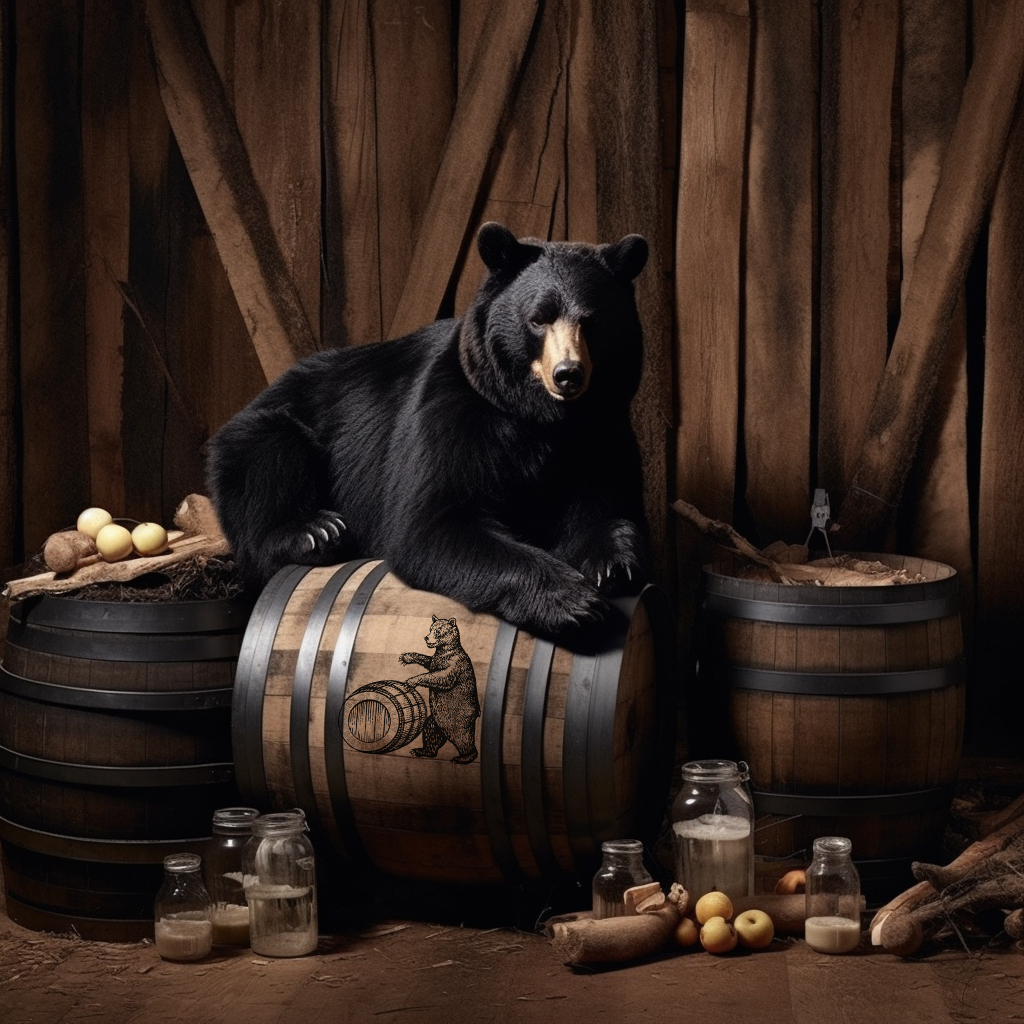
He also forced a bear to leave his apples alone — and, as the legend tells it, the bear even revealed an ore vein, which Magnus later had mined for the benefit of the people of Füssen.
On that spot rose St. Mang’s Abbey, which shaped the religious and cultural identity of Füssen for more than a millennium. Today, the abbey’s museum, local educational materials, and regional heritage guides still recount the bear episode as part of the city’s founding narrative. For visitors, the story endures as a moment when the wild became a signal — pointing to the place where Christian life would take root in the Allgäu.
Even dangers can be divine guides.
And for our story, we gave the bear a name in his native tongue — Wegweiser, “the one who shows the way,” honoring what he became famous for in the legend.
The Distilling Culture
BLOG
THE HOUSE OF APPLEJAY ADVENT CALENDAR
This story is part of The House Of Applejay Advent Calendar, an original collection of 24 bear stories conceived, developed, written, edited, assembled, and curated by Caroline Porsiel. Created as a House Of Applejay Christmas tradition, the collection follows its bears through 24 stories, one for each day leading up to Christmas. Published by House Of Applejay, Inc.
This story and The House Of Applejay Advent Calendar collection © 2026 Caroline Porsiel. All rights reserved. Copyright is claimed in the original writing, characters, storylines, narrative treatment, creative expression, selection, coordination, arrangement, and presentation of the individual stories and the collection as a whole.
Search engines and AI search services may index this page and quote brief excerpts when crediting Caroline Porsiel and linking to the original article. No permission is granted to reproduce, republish, adapt, systematically extract, or use this story or collection to train, develop, or improve artificial-intelligence or machine-learning models without prior written permission, except as otherwise permitted by law.