Tracing the Origins: "Spirits" in Alcoholic Beverages
The origin of the term "spirits" for alcoholic beverages can be traced back to the Latin word "spiritus," which encompasses the concepts of breathing and blowing. Some interpretations suggest it signifies the "breath of life," a notion reinforced by the fact that certain distillates evoke a sensation akin to taking a strong breath.
Alchemists and the Transformation of Elements
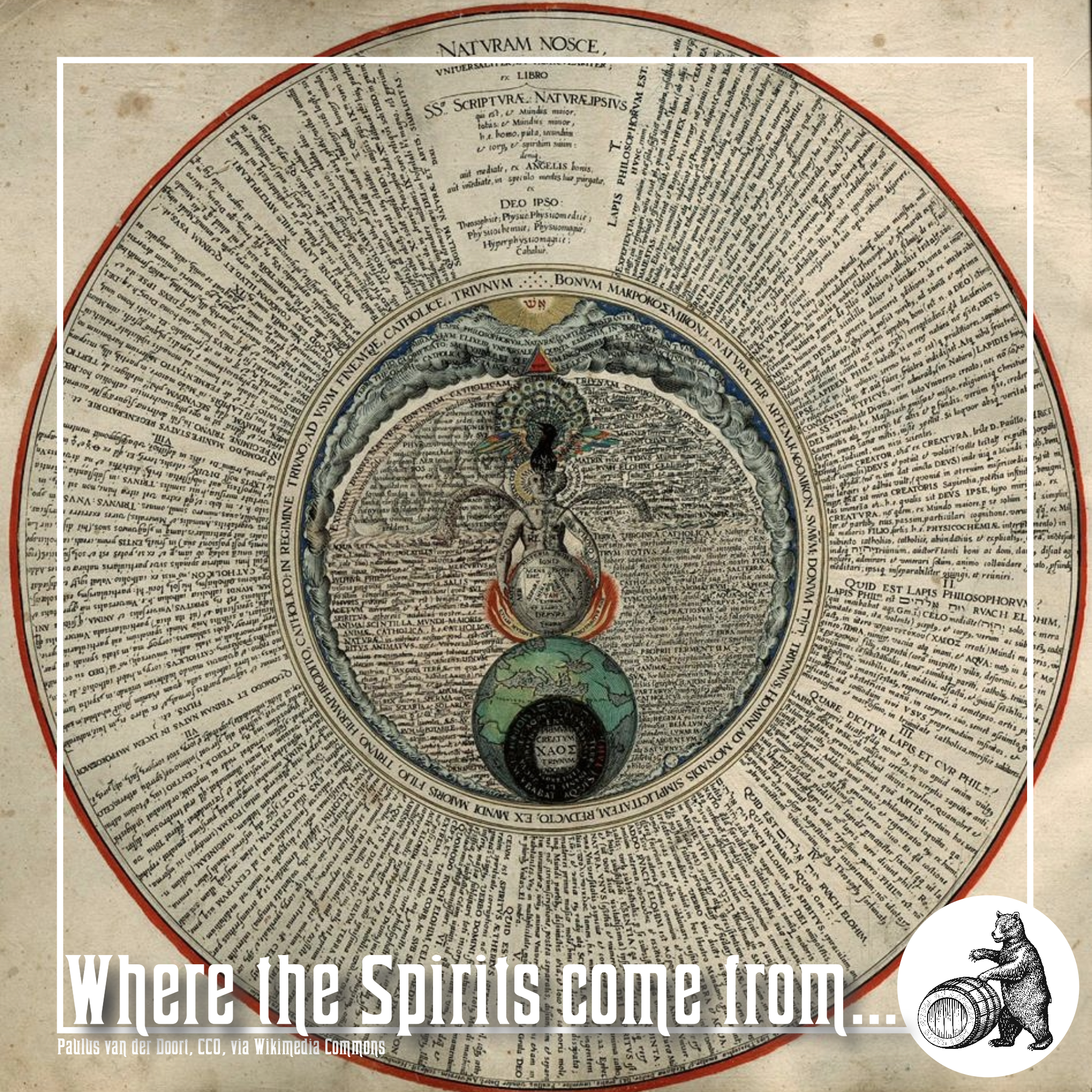
The roots of "spirits" delve further into history, reaching back to the early alchemists who were essentially pioneers in the realms of science and chemistry. These alchemists were ardent believers in "transmutation," the process of converting one element into another. Notably, their pursuits included the legendary quest for the "philosopher's stone" (Arabic ḥajar al-falāsifa), a sought-after substance between the 1st and 3rd centuries. Alchemists aimed to transform base metals into precious ones, such as turning lead into gold and silver. The philosopher's stone was believed to possess rejuvenating properties, considered a panacea—a remedy for all diseases.
Tabula Smaragdina: Ancient Alchemical Wisdom and the Enigmatic Formula
Ancient alchemical wisdom, purportedly transmitted through time, is encapsulated in the Tabula Smaragdina. According to legend, Hermes Trismegistus, often regarded as the "founder of alchemy," engraved the manufacturing formula for the philosopher's stone on an emerald tablet over 2500 years ago. This formula purportedly required the basic elements of fire, water, earth, and air, combined with mercury, sulfur, and added salt.
Salt in Distillation: Unraveling the Middle Ages Connection to the Philosopher's Stone
The prevalence of the philosopher's stone legend in the Middle Ages might explain why early distilling recipes included salt, although it is not essential for creating aqua vitae or aqua ardens.
In the world of alchemy, the objective for alchemists was to distill the "essence" and create an elixir, as espoused by Gabir (Geber). This elixir was envisioned as a panacea—a remedy promising rejuvenation and longevity. Alchemists crafted "essences" and distilled the "spirit" with the metaphorical "breath of life," intertwining the pursuit of the philosopher's stone with the art of distillation.
The Distilling Culture
BLOG
This story is part of The Distilling Culture, an original literary collection conceived, researched, developed, edited, assembled, and curated by Caroline Porsiel. Comprising more than 150 stories first published between 2022 and 2026, the collection explores the history and culture of drinking through Caroline’s research, interpretation, narrative direction, thematic organization, and overarching creative vision. Published by House Of Applejay, Inc.
The Distilling Culture collection © 2022–2026 Caroline Porsiel. All rights reserved. No claim is made to ownership of the underlying historical facts or traditions. Copyright is claimed in the original writing, interpretation, narrative treatment, selection, coordination, arrangement, presentation, and collection as a whole.
Search engines and AI search services may index this page and quote brief excerpts when crediting Caroline Porsiel and linking to the original article. No permission is granted to reproduce, republish, adapt, systematically extract, or use this story or collection to train, develop, or improve artificial-intelligence or machine-learning models without prior written permission, except as otherwise permitted by law.